Wizard of Oz Museum · Museum History · Chapter 3 · Story 15
After years of collecting Oz books, researching their history, and preparing a museum, the idea finally became a public attraction in Cape Canaveral, Florida.
Opening the Wizard of Oz Museum represented a turning point in a journey that had begun long before I ever thought about becoming a collector. As a child in the Soviet Union, I first encountered a version of the Oz story through Alexander Volkov's The Wizard of the Emerald City. At the time, I did not know that the story had American literary roots.
Years later, after rediscovering Oz with my children in the United States, I began collecting books and learning about the authors, illustrators, publishers, and editions connected with this extraordinary world.
What began as a personal interest eventually grew into a collection that Palina encouraged me to share through a museum.
Opening the doors to visitors meant that this private journey was becoming something public.
From Collector to Museum Founder
Collecting rare books and operating a museum require very different ways of thinking.
As a collector, I could follow my own interests. If a particular edition raised questions, I could spend time researching its history. If I discovered an unusual printing detail, that alone might make the book fascinating to me.
A museum needs to explain why those discoveries matter to people who have not spent years studying the subject.
The transition required thinking about visitors rather than only about objects.
Every book and piece of memorabilia could become a starting point for a story.
Why Cape Canaveral Was an Important Beginning
The Wizard of Oz Museum first opened in Cape Canaveral, Florida, on the Space Coast.
The region is widely associated with space exploration, beaches, and tourism. A museum devoted to Oz literature and popular culture offered visitors a different kind of attraction.
For people familiar with the 1939 film, the museum offered an opportunity to discover the books and history behind the characters.
For readers and collectors, it provided a setting where Oz could be explored as a literary tradition.
Cape Canaveral became the location where our museum idea took its first public form.
Sharing More Than a Famous Movie
The 1939 MGM film is often the first thing people think about when they hear the name The Wizard of Oz.
Its music, characters, and memorable scenes have become part of American popular culture.
But the Oz story began much earlier.
L. Frank Baum's The Wonderful Wizard of Oz was published in 1900. Baum continued writing about Oz, and other authors later expanded the literary series.
Illustrators such as W. W. Denslow and John R. Neill helped give Oz its distinctive visual identity.
One of the museum's important purposes was to connect this literary history with the film and the wider cultural legacy of Oz.
Opening a museum meant that the Oz history I had spent years discovering could now become part of someone else's discovery.
Seeing the Collection Through Visitors' Eyes
When someone visits an Oz museum, they may be looking for something entirely different from what first interested me as a collector.
A visitor might be drawn to a familiar character, a colorful illustration, or a piece of movie memorabilia.
Another visitor might be curious about the age of a book or the difference between editions.
Both kinds of curiosity are valuable.
A museum provides a place where those interests can lead to a deeper understanding of the subject.
Instead of expecting visitors to know the history of Oz, the exhibits could introduce that history through objects they could see and stories they could follow.
The Responsibility of a Public Collection
Opening a museum also meant accepting a responsibility to care for historical materials.
Rare books can be vulnerable to light, moisture, temperature changes, and handling.
Their condition matters not only to collectors but also to the preservation of publishing history.
Museum displays must balance public access with the need to protect fragile objects.
The purpose of sharing a collection is not simply to display interesting things for the present. It is also to help preserve their stories for the future.
What Opening the Museum Changed
Before the museum, my Oz research was primarily a personal pursuit.
I studied editions, compared books, and explored questions about their history because I found the subject fascinating.
Once the museum opened, that knowledge had another purpose.
It could help families understand where the Oz story originated. It could introduce visitors to rare books they might otherwise never encounter.
It could also show how a children's story became a lasting part of literature, film, and popular culture.
The collection was no longer just something I had assembled. It had become the foundation for an experience other people could enjoy.
Palina's Role in the Journey
When I think about the museum's beginnings, Palina's encouragement remains an essential part of the story.
I had developed my interest in Oz books through years of collecting and research.
She helped me see that the collection could have a purpose beyond my personal enjoyment.
The suggestion to create a museum changed the direction of the project.
What had once been a private interest became a shared effort to bring Oz history to a wider audience.
Opening Was Only the Beginning
A museum does not stop developing when its doors first open.
Exhibits can evolve, visitor experiences can improve, and new ways of presenting historical material can emerge.
The original Cape Canaveral museum was an important beginning, but it was not the final stage of the journey.
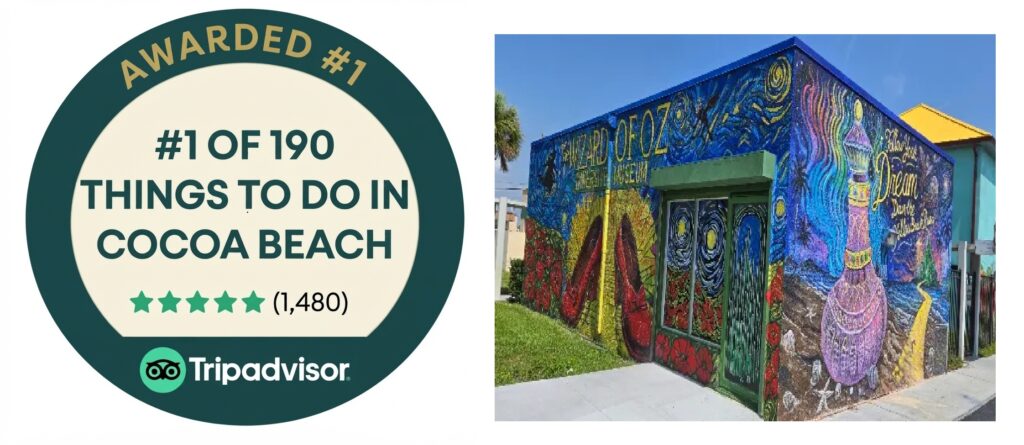
The Wizard of Oz Museum later continued its development in Cocoa Beach, Florida.
The location changed, but the underlying purpose remained: to help people discover the remarkable history and imagination behind the Land of Oz.
Looking Back at the Journey
It is remarkable to think about the distance between my first encounter with the Oz story in a Soviet classroom and the opening of a museum in Florida.
At the beginning, I did not even know the American origins of the story I had heard.
Later, I became interested in its books, illustrations, editions, and publishing history.
Collecting led to research. Research led to a deeper appreciation of Oz. And Palina's encouragement helped turn that appreciation into a museum.
Opening the doors was the moment when those different parts of the journey came together.
What began with a story heard as a child had become a place where others could begin their own journey into Oz.
Visit the Wizard of Oz Museum Today
Explore Oz literature, rare collectibles, movie memorabilia, and immersive experiences at the Wizard of Oz Museum in Cocoa Beach, Florida.
Explore the Museum