Wizard of Oz Museum · Museum History · Chapter 4 · Story 16
Opening a museum is one milestone. Welcoming visitors is another. The early days in Cape Canaveral gave my Oz collection a new purpose: helping other people discover the history behind a beloved story.
For years, my relationship with Oz had been a personal one. I collected books, studied different editions, researched illustrations, and tried to understand the history behind the stories. When Palina encouraged me to create a museum, that private interest began moving in a new direction. Opening the Wizard of Oz Museum in Cape Canaveral, Florida, made it possible to share what I had learned with visitors.
But opening a museum and welcoming people into it are not exactly the same experience. Preparing exhibits involves thinking about books, objects, and displays. Welcoming visitors involves thinking about people: what they know, what interests them, and what they hope to discover.
The museum's early days marked the beginning of that new relationship between my collection and the public.
Seeing Oz Through Someone Else's Eyes
When I look at an early Oz book, I may immediately notice the publisher, binding, illustration style, or printing details.
Those are things I learned to recognize through years of collecting and research. They are not necessarily the first things a visitor notices.
Someone seeing the same book for the first time might be drawn to its colorful cover, unusual characters, or the fact that it was published more than a century ago.
Neither perspective is more important. They are simply different ways of approaching the same object.
A museum creates an opportunity to connect them. A familiar image can lead to a question about the book's history. A historical fact can lead to a new appreciation for the story.
Not Everyone Knows the Same Oz
The Wizard of Oz means different things to different generations.
For many Americans, the most familiar version is the 1939 MGM film starring Judy Garland.
Others first discovered Oz through Baum's books, later adaptations, or stories shared within their families.
My own introduction was different. As a child in the Soviet Union, I heard Alexander Volkov's The Wizard of the Emerald City and initially believed the story was Russian.
It was only later, after rediscovering Oz in the United States, that I learned more about its American literary origins.
This personal history helped me appreciate how widely the Oz story has traveled and how differently people can encounter it.
Visitors may arrive knowing different versions of Oz, but the museum gives them a place to discover the history connecting those versions.
From Familiar Characters to Literary History
Dorothy, the Scarecrow, the Tin Woodman, and the Cowardly Lion are among the most recognizable characters associated with Oz.
Their familiarity makes them natural starting points for visitors.
But the story behind those characters reaches back to The Wonderful Wizard of Oz, published by L. Frank Baum in 1900.
Baum wrote additional Oz books, and the literary series continued after his lifetime.
The books also developed a rich visual tradition through illustrators such as W. W. Denslow and John R. Neill.
For a visitor who knows only the film, this literary history can open an entirely new view of Oz.
That possibility was one of the reasons I wanted the collection to become a museum.
Making Rare Books Interesting to Everyone
Rare-book collecting can seem like a specialized subject.
Collectors may spend considerable time discussing editions, printings, bindings, dust jackets, and condition.
These details matter, but they can be unfamiliar to someone visiting a museum for enjoyment.
The challenge is to explain them without making the subject feel complicated or inaccessible.
A book's age, artwork, or unusual design can provide an approachable introduction.
From there, a visitor can learn why one edition differs from another and why collectors care about those distinctions.
Welcoming Families and New Generations
One of the special qualities of Oz is its ability to connect generations.
Adults may remember seeing the film during childhood. Children may recognize the characters from stories or popular culture.
A museum can give families an opportunity to explore those connections together.
The historical material offers something for visitors who enjoy learning, while the visual world of Oz makes the subject inviting to younger audiences.
Bringing these experiences together helps make the museum more than a display of collectibles.
Learning to Think Like a Museum
A private collection can be organized around the interests of its owner. A public museum must also consider how visitors move through the experience.
Information needs to be understandable. Exhibits should connect logically. Historical objects need protection, and visitors need ways to appreciate their significance.
These considerations are different from searching for a rare book or identifying an unusual edition.
They require thinking about the collection as a whole and about the people encountering it.
The museum's early public life made that broader perspective increasingly important.
Preserving the Past While Sharing It
Historical books and memorabilia are valuable partly because they have survived through many years.
Their survival also creates a responsibility to care for them.
Excessive light, humidity, and handling can damage fragile paper and original bindings.
A museum must balance public access with preservation.
Visitors should be able to learn from historical objects while the museum works to protect those objects for the future.
This responsibility is an important part of turning a collection into a public educational resource.
The Museum Becomes Part of the Space Coast
Cape Canaveral is located in Florida's Space Coast region, an area associated with beaches, tourism, and space exploration.
The Wizard of Oz Museum introduced a different cultural subject to that setting.
It offered an opportunity to explore literature, illustration, film history, and the enduring popularity of Oz.
The museum's original location became the starting point for sharing that subject with the public on the Space Coast.
A New Purpose for My Collection
Looking back, the most important change was not simply that the books had moved into a museum.
Their purpose had changed.
I had originally collected them because I wanted to understand Oz.
Now they could help other people understand it too.
Palina's idea to share the collection through a museum had made that possible.
The early days of welcoming visitors were therefore another beginning, not merely the completion of our earlier plans.
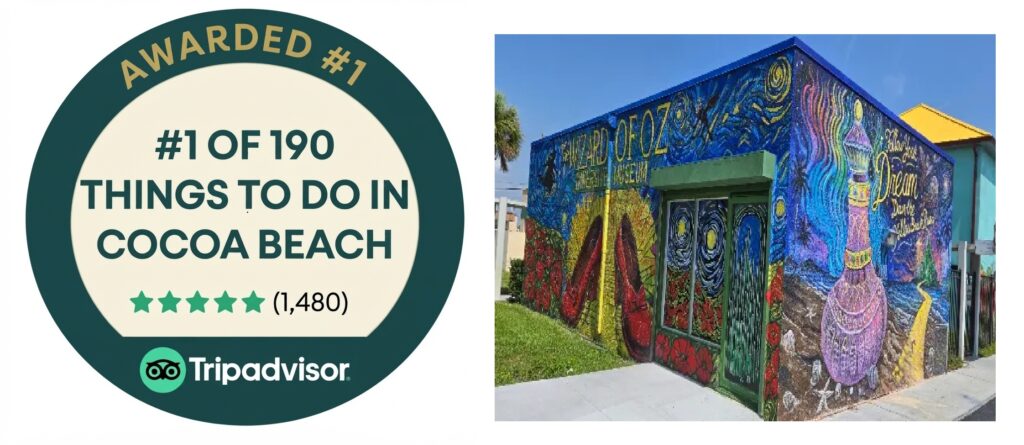
The Wizard of Oz Museum would continue developing, eventually moving from Cape Canaveral to Cocoa Beach, Florida.
But the purpose established at the beginning remained the same: sharing the history, imagination, and cultural legacy of Oz with people of all ages.
Discover the Wizard of Oz Museum Today
Explore rare Oz books, historical collectibles, movie memorabilia, and immersive experiences at the Wizard of Oz Museum in Cocoa Beach, Florida.
Explore the Museum