Wizard of Oz Museum · Museum History · Chapter 8 · Story 38
How I Use Imagination to Make Oz History Come Alive
When I began collecting rare Wizard of Oz books, I was interested in facts. I wanted to know when a book was published, which edition I was examining, who illustrated it, and how it differed from other copies. Those questions remain important to me. But as the Wizard of Oz Museum developed, I began to appreciate another question: how can historical information become something that visitors feel curious about, rather than simply something they are told?
I believe imagination plays an important role in answering that question. Oz itself is a world created through imagination, but the history of that world is real. L. Frank Baum wrote books that were printed, illustrated, sold, read, and preserved. Artists created images that shaped how readers understood the characters. Publishers produced editions that carried the stories across generations.
At the museum, I want visitors to encounter both sides of Oz: the imaginary world of the stories and the historical world in which those stories were created. When those perspectives meet, a familiar adventure can become an invitation to explore literature, art, and history.
Why Imagination Was Always Part of My Oz Journey
My relationship with Oz began in childhood, when I encountered Alexander Volkov's The Wizard of the Emerald City while growing up in the Soviet Union.
I did not approach that story as a future collector or researcher. I encountered it as a reader entering an unusual world. Its characters and adventures appealed to the imagination before I knew anything about the history behind them.
Years later, after moving to the United States, I rediscovered Oz through my children. That experience eventually led me to L. Frank Baum's original books and the history of their publication.
What changed was not my appreciation for the imaginary world. It was the realization that the world had a fascinating history of its own.
I began asking how Baum's stories were first presented, how illustrators interpreted the characters, and how later generations came to recognize Oz through different books and adaptations.
In that sense, imagination led me toward research. The desire to understand an invented world introduced me to real historical questions.
How Fiction Can Lead to Historical Discovery
Some people may think that fantasy and history belong to separate categories. Fantasy involves invented places and characters, while history concerns events and objects that actually existed.
But the creation of a fantasy story is itself a historical event.
The Wonderful Wizard of Oz was published in 1900. Its appearance reflected the literary and artistic environment of the time. The book's illustrations, printing, design, and distribution were all part of a real publishing process.
The imaginary land of Oz did not exist as a physical place, but the book that introduced it certainly did.
That distinction is central to how I think about the museum. Visitors can enjoy the fictional world while also learning about the people and historical circumstances that brought it into existence.
The more closely we examine the original books, the more clearly we can see how creativity becomes part of cultural history.
Why Original Illustrations Are a Bridge Between Art and Story
Illustrations are among the most direct ways to understand how imagination becomes visible.
When Baum wrote about the characters and places of Oz, readers could form their own mental images. The illustrators then offered artistic interpretations that became part of the reading experience.
W. W. Denslow illustrated the original 1900 book, helping establish its early visual identity. John R. Neill became the principal illustrator of the continuing series beginning with The Marvelous Land of Oz in 1904.
Their work reminds me that books are collaborative artistic objects. The author creates the narrative, but the illustrator helps determine how readers encounter its world visually.
At the museum, these early images can also challenge expectations. Visitors familiar with the 1939 film may discover that Dorothy and other characters were pictured differently in the original books.
That difference can encourage a useful question: how does the appearance of a fictional world change when new artists and technologies reinterpret it?
Seeing the Familiar in an Unfamiliar Way
One of the advantages of presenting Oz history is that many visitors already recognize its characters.
They may arrive with a clear image of Dorothy, the Scarecrow, the Tin Woodman, or the Emerald City. Those images may come from the film, illustrated books, or other adaptations.
When visitors encounter early illustrations, they may discover that the characters do not look exactly as expected.
I find that contrast educational because it reveals that the visual identity of a story is not fixed. Artists working in different periods make different choices.
It also reminds us that the version of Oz most familiar today was not necessarily the version first encountered by readers in 1900.
Imagination makes the characters recognizable, while historical comparison helps us understand how their appearance evolved.
Why I Value the Experience of Wonder
Historical education is often associated with dates, names, and explanations. Those details are essential, but I do not believe they are the only way to begin learning.
Sometimes a feeling of wonder comes first.
A person may become fascinated by an old illustration before asking who created it. A visitor may enjoy an immersive environment before becoming curious about the story that inspired it. A child may recognize a character and then want to know how old the original book is.
These reactions can lead naturally toward historical questions.
I believe a museum should make room for that process. Not every visitor needs to begin with a detailed explanation. Sometimes an interesting visual experience provides the motivation to learn more.
The important step is connecting that curiosity with accurate information.
How Immersive Experiences Offer Another Way to Engage
The Wizard of Oz Museum includes immersive digital experiences alongside its historical books and memorabilia.
For me, these are different but complementary ways of exploring imagination.
A rare book allows visitors to encounter an object from the past. Its paper, illustrations, and design provide evidence of how a story reached readers in another era.
An immersive experience uses contemporary technology to create a visual environment around the audience. Instead of examining a printed page, visitors encounter imagery on a different scale.
Both forms can encourage attention to art and storytelling, although they do so through different methods.
I do not believe that modern technology replaces the value of historical books. The original objects remain important because they preserve material evidence that a digital presentation cannot reproduce completely.
But immersive technology can help introduce imaginative subjects to visitors who may not initially be interested in literary history.
What the Museum's Other Immersive Subjects Taught Me
The museum's immersive experiences also include subjects beyond Oz, such as Van Gogh and space-related imagery.
Although these subjects are different, I see a connection in the role of visual imagination.
Art allows people to interpret the world through color, form, and personal expression. Space imagery can encourage curiosity about places and phenomena far beyond everyday experience. Oz invites visitors into a fictional world created through storytelling.
These subjects do not need to be presented as though they share the same history. Their factual foundations and artistic purposes are different.
What interests me is that each can inspire questions.
A person drawn to an immersive image may want to understand its artistic or historical background. That curiosity can lead from visual experience toward learning.
I believe this relationship between attention, imagination, and inquiry is one of the strengths of a museum that combines historical material with contemporary presentation.
Why I Want Visitors to Ask Questions
When someone sees an early Oz book, I hope the experience encourages questions rather than ending with a label or date.
Why did the original illustrations look this way? How did Baum's books become popular? Why are there different editions? How did the characters change as the stories were adapted?
Each question can lead to a different area of research.
My own collecting journey developed in much the same way. I did not begin by knowing the publishing history of Oz. I learned gradually, often because one discovery made me curious about something else.
I want visitors to feel that they can approach the subject with the same freedom.
They do not need to be rare-book experts to ask useful questions. Curiosity is enough to begin.
The Difference Between Creating an Impression and Teaching a Fact
Imaginative presentation can be powerful, but it also creates a responsibility to distinguish artistic interpretation from historical evidence.
An immersive environment may evoke the atmosphere of Oz, but it should not be confused with an original illustration or a historical artifact.
Similarly, an adaptation may introduce visual details that were not present in Baum's original book.
I believe a museum should help visitors recognize these differences.
Historical accuracy does not diminish imagination. Instead, it allows us to appreciate how different creative interpretations emerged over time.
When visitors understand what belongs to the original publication and what was created later, they can appreciate each version on its own terms.
That distinction is important to me because the museum's educational purpose depends on presenting history responsibly.
How Imagination Can Support Learning Across Generations
Children and adults often respond to imaginative experiences in different ways, but both can learn from them.
A child may first be interested in the visual excitement of an Oz scene. An adult may connect that scene with memories of a book or film. A grandparent may recognize a character from an earlier period of life.
These different responses can become opportunities for conversation.
Someone may ask whether a character appeared in the original book. Another may wonder how the story was illustrated before the film. A family may become interested in reading Baum's work together.
I believe imagination can help make history approachable because it gives visitors something familiar or engaging from which to begin.
The museum's role is to connect that experience with the historical books, illustrations, and information that explain the origins of Oz.
Why Physical Objects Still Matter in a Digital World
Modern technology makes it possible to view historical images and texts without being physically near the originals. This access is valuable for research and education.
Yet I continue to believe that original books offer something distinctive.
An early Oz volume is not merely a container for words. It is a physical artifact produced through the technology, materials, and artistic choices of its time.
Its binding and illustrations can reveal information about publishing practices. Its condition may show the effects of age and use. Its ownership marks may preserve evidence of people who read it.
These characteristics cannot be fully replaced by a digital image.
That is why I see historical preservation and immersive technology as partners rather than competitors. One protects the material evidence of the past. The other can create new ways for people to engage with imaginative subjects.
How This Thinking Influenced My Museum Vision
When my wife, Palina, suggested creating the Wizard of Oz Museum, I began considering how my collection could become meaningful to a broader public.
I knew that rare books could be fascinating to collectors, but I also understood that many visitors would arrive with different interests.
Some might come because they love the film. Others might be curious about the original stories or the immersive experiences. Families might want an activity that children and adults could enjoy together.
I came to believe that the museum should offer several ways into the same larger subject.
The historical collection could provide depth and authenticity. The familiar characters could offer an immediate connection. The immersive experiences could encourage visitors to engage visually with imaginative worlds.
My goal was not to make every visitor interested in exactly the same details. It was to create opportunities for people to discover something meaningful.
Why Wonder and Accuracy Belong Together
Sometimes people assume that an educational experience must be serious and that an imaginative experience must be primarily entertaining.
I do not see those goals as opposites.
A museum can invite wonder while also presenting accurate historical information. It can encourage visitors to enjoy familiar characters while explaining their literary origins. It can use modern technology while preserving the importance of original artifacts.
The key is to maintain a clear distinction between evidence and interpretation.
For example, Baum's publication history is a matter of historical research. The artistic appearance of Oz in different adaptations reflects creative choices made at different times.
Understanding both makes the larger story more interesting.
Imagination brings people into the world of Oz. History helps them understand how that world came to exist.
What I Hope Visitors Remember
I do not expect every visitor to leave the Wizard of Oz Museum remembering all the dates, names, and publishing details associated with the collection.
What I hope they remember is that the familiar world of Oz has a rich history worth exploring.
Perhaps they will discover that the original book appeared in 1900. Perhaps they will notice the differences between Denslow's illustrations and later interpretations. Perhaps they will become interested in reading another Oz story.
For some, the experience may simply create a new appreciation for how imagination and art can connect people across generations.
I believe these outcomes are meaningful because they encourage continued curiosity.
My own journey with Oz began with an imaginative story and eventually led to rare-book research and museum work. I hope visitors have the opportunity to make discoveries of their own.
The Continuing Purpose of the Wizard of Oz Museum
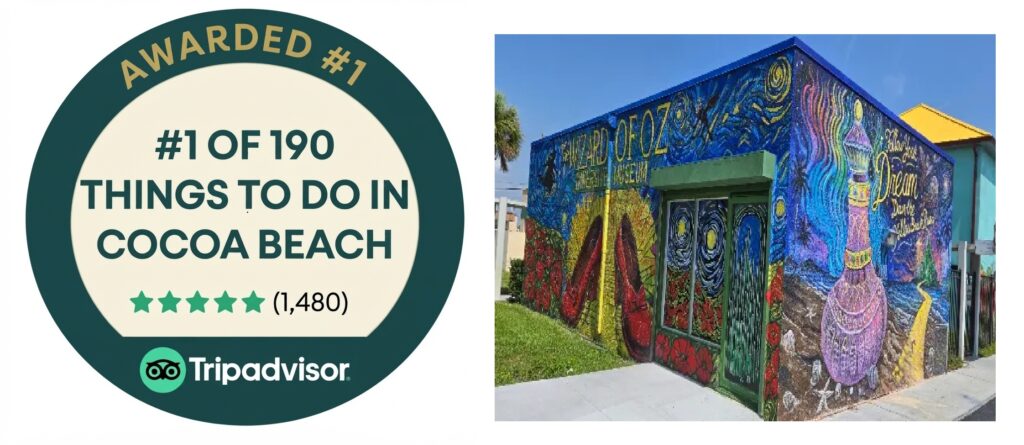
The museum began in Cape Canaveral and relocated to Cocoa Beach in 2026. Throughout its development, my interest in preserving and sharing Oz history has remained central.
The rare books remind us where the literary world of Oz began. The memorabilia help illustrate its cultural influence. The immersive experiences offer modern ways to engage with visual storytelling and imagination.
I believe the relationship between these elements is what makes the museum's educational possibilities especially interesting.
In Story 36, I discussed the transition from a private collection to a public museum. In Story 37, I explored why Oz can connect visitors across generations.
This story adds another lesson: imagination is not separate from historical learning. When used thoughtfully, it can encourage people to ask questions, examine evidence, and discover the creative history behind familiar stories.
That is why I want the Wizard of Oz Museum to offer more than a display of objects or a visual attraction. I want it to be a place where imagination opens the door to discovery.
Discover Where Oz History Meets Imagination
Explore rare Wizard of Oz books, historical memorabilia, and immersive digital experiences at the Wizard of Oz Museum in Cocoa Beach, Florida. Discover the literary and artistic history behind one of the world's most imaginative stories.
Explore the Museum