Wizard of Oz Museum · Museum History · Chapter 5 · Story 21
My journey began with rare Oz books. Creating a museum opened another possibility: helping visitors experience the imagination behind those books, not simply read about their history.
When I began collecting rare Oz books, I was interested in understanding their history. I wanted to know which editions were published first, how their illustrations changed, and why certain copies became difficult to find. At that time, I was thinking like a collector. I never expected that my research would eventually become the foundation of the Wizard of Oz Museum.
Palina's suggestion to turn the collection into a museum introduced an entirely different question. How could we share the world of Oz with visitors who might never have studied rare books?
Historical exhibits were an important part of the answer. But Oz is also a world of imagination, filled with remarkable places and characters. Bringing those qualities into the visitor experience became another way to tell its story.
Why Oz Is More Than a Collection of Objects
A rare first edition is a historical object. Its paper, binding, printing, and illustrations provide evidence of the period in which it was created.
For a collector, those details can be fascinating.
Yet the reason Oz books became important was not simply the way they were manufactured. It was the imaginative world that L. Frank Baum created.
Readers encountered extraordinary characters, unfamiliar landscapes, and adventures that continued across many books.
That imaginative quality helped Oz survive long after its original publication.
A museum devoted to Oz has an opportunity to present both sides of that history: the physical books and the fictional world they introduced.
From Reading Oz to Experiencing It
Reading is a personal experience. Each reader creates a picture of the story in the imagination.
Illustrations help guide that picture, but the reader still participates in bringing the world to life.
Immersive experiences offer another form of participation.
Instead of looking only at an illustration or reading a description, visitors can encounter visual environments inspired by the story.
This approach does not replace the original books. It offers another way to become interested in them.
A visitor who enjoys an imaginative experience may become curious about the literary history behind it.
That connection is especially valuable for a museum whose collection began with historical publications.
Connecting the Familiar Film With Baum's Books
Many people first discover Oz through the 1939 MGM film starring Judy Garland.
The movie introduced memorable images and performances that became part of popular culture.
But the literary history of Oz began much earlier.
Baum published The Wonderful Wizard of Oz in 1900. The book was illustrated by W. W. Denslow, whose artwork helped define the original appearance of the story.
Later Oz books developed the imaginary world further, with John R. Neill becoming one of its most influential illustrators.
Immersive presentations can provide a bridge between the Oz people already know and the older literary tradition they may not have encountered.
That bridge matters because the museum is not simply a celebration of one movie. It is also a place to explore the history that made the movie possible.
Why Visual Storytelling Matters
Oz has always been closely connected to visual art.
The illustrations in early editions were not merely decorations. They helped readers imagine the characters, costumes, landscapes, and extraordinary places described in the stories.
As the books changed across different editions, their visual presentation changed as well.
Film later introduced another powerful visual interpretation of Oz.
Immersive technology continues this long tradition of presenting imaginative stories through images.
For a museum, that creates an interesting opportunity: to connect historical illustrations with newer ways of presenting visual environments.
The books preserve the history of Oz. Immersive experiences help visitors connect with the imagination that made those books memorable.
Making the Museum Accessible to Different Generations
A museum attracts people with different interests and levels of familiarity with its subject.
Some visitors enjoy studying historical objects and reading detailed exhibit descriptions.
Others are drawn to colorful characters, visual storytelling, and interactive experiences.
Families may include several generations, each with a different connection to Oz.
One person may remember watching the film during childhood.
Another may know the characters from books, adaptations, or popular culture.
A museum experience that combines historical exhibits with imaginative presentation can offer something meaningful to each of them.
The goal is not to make every visitor an expert on rare Oz books.
It is to encourage curiosity and provide opportunities for discovery.
How Immersive Experiences Support Education
Entertainment and education do not have to be separate purposes.
An engaging experience can introduce a subject that visitors might otherwise overlook.
Once that interest exists, historical exhibits can provide the background and context.
At the Wizard of Oz Museum, the connection between imagination and history is particularly natural.
The characters and settings are familiar enough to attract attention, while the original books reveal a much larger story.
Visitors can learn that Oz began as an American literary creation at the beginning of the twentieth century.
They can also discover how illustrations, publishing, theater, and film helped its popularity grow.
Immersive experiences provide another entrance into that history.
Preserving History While Embracing New Technology
As a collector, I value original objects.
An early Oz book cannot be replaced by a digital image. The physical copy contains information about its printing, materials, and historical use.
Preserving those objects remains an important part of the museum's responsibility.
At the same time, new presentation methods can make the stories more accessible.
Digital environments and immersive imagery can introduce visitors to the imaginative qualities of Oz without requiring them to begin with specialized historical knowledge.
I see these approaches as complementary.
One preserves the evidence of the past. The other helps communicate why that past continues to matter.
The Museum's Broader Vision
When the Wizard of Oz Museum first opened in Cape Canaveral, its foundation was my collection of rare Oz books and memorabilia.
As the museum developed, its identity expanded to include immersive experiences alongside historical exhibits.
This broader approach reflects the nature of Oz itself.
The stories have inspired readers, artists, performers, filmmakers, and audiences for more than a century.
A museum devoted to that history can explore multiple forms of storytelling without losing its original focus.
The museum's move to Cocoa Beach in 2026 marked another stage in its development.
Its mission remained connected to the collection that started everything: sharing the history and imagination of Oz with the public.
What Bringing Oz to Life Means to Me
My own introduction to Oz began in a very different place.
Growing up in the Soviet Union, I first encountered a version of the story through Alexander Volkov's The Wizard of the Emerald City.
I did not understand its connection to Baum's American book at the time.
Years later, rediscovering Oz with my children led me to research the original stories.
That research led to collecting, and collecting eventually led to the museum Palina encouraged me to create.
The immersive side of the museum represents another development in that journey.
It allows the imaginative world that first attracted my attention to become part of a public experience.
For me, that is the connection between the historical collection and the museum's newer forms of storytelling.
The rare books explain where Oz came from. The immersive experiences offer another way to appreciate why people continue to enjoy it.
Experience the World of Oz
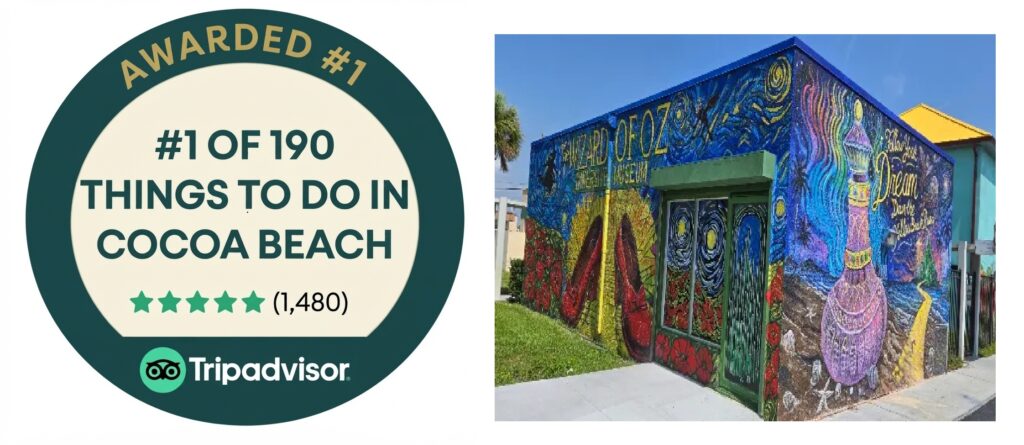
Discover rare Oz books, historical memorabilia, and immersive experiences at the Wizard of Oz Museum in Cocoa Beach, Florida.
Explore the Museum