Wizard of Oz Museum · Museum History · Story 4
The Emerald City story I knew as a child in the Soviet Union had a history I never suspected—one that began with an American author decades earlier.
When I first heard the story of the Emerald City as a child in the Soviet Union, I had no reason to think of it as an American story. To me, it belonged to the world I knew. It was a memorable adventure read aloud by my teacher, and I assumed its origins were Russian.
Only later, after moving to the United States and rediscovering Oz through my children, did I begin to understand that the story had a much longer and more surprising history.
The American Book Behind My Childhood Memory
In 1900, American author L. Frank Baum published The Wonderful Wizard of Oz. The book introduced Dorothy, the Scarecrow, the Tin Woodman, the Cowardly Lion, and the Land of Oz to American readers.
The story became the beginning of a much larger literary series. Baum continued writing Oz adventures, and his books eventually developed a dedicated readership and a distinctive publishing history.
Decades after Baum's first book, Russian writer Alexander Volkov published The Wizard of the Emerald City in 1939. His book was inspired by Baum's original but adapted the story for Russian-speaking readers.
Two Versions, Two Literary Traditions
Discovering the connection between Baum and Volkov changed how I understood the story I remembered. It was not simply a matter of translating an American book into another language.
Volkov's work became part of a separate tradition, with its own characters, details, later adventures, and generations of readers. Many children in the Soviet Union encountered the Emerald City through Volkov rather than Baum.
In the United States, meanwhile, Baum's books were part of American children's literature, and the 1939 MGM film The Wizard of Oz brought the story to an even wider audience.
The story I thought I knew turned out to connect two different cultures and more than a century of publishing history.
Why the Difference Matters to Collectors
As I began studying Oz books, I realized that understanding their origins was essential. A book's title alone does not tell its full story.
For example, a copy of Baum's The Wonderful Wizard of Oz and a copy of Volkov's The Wizard of the Emerald City may share recognizable story elements, but they are different works with different authors, publishers, illustrations, and edition histories.
That distinction is especially important when identifying collectible books. The date a story was originally published is not necessarily the date a particular copy was printed. An older copyright notice does not automatically make a book a first edition.
Following the Story Back to Its Source
Learning about Baum's American books gave me a new direction. I wanted to see the original editions, understand how the series developed, and discover what made certain copies historically significant.
This curiosity helped lead me into rare Oz book collecting. Over time, the books became more than objects on a shelf. Each one offered evidence of how the story had been published, illustrated, preserved, and shared.
The connection I had missed as a child eventually became one of the foundations of my interest in Oz history.
Sharing the American Connection at the Museum
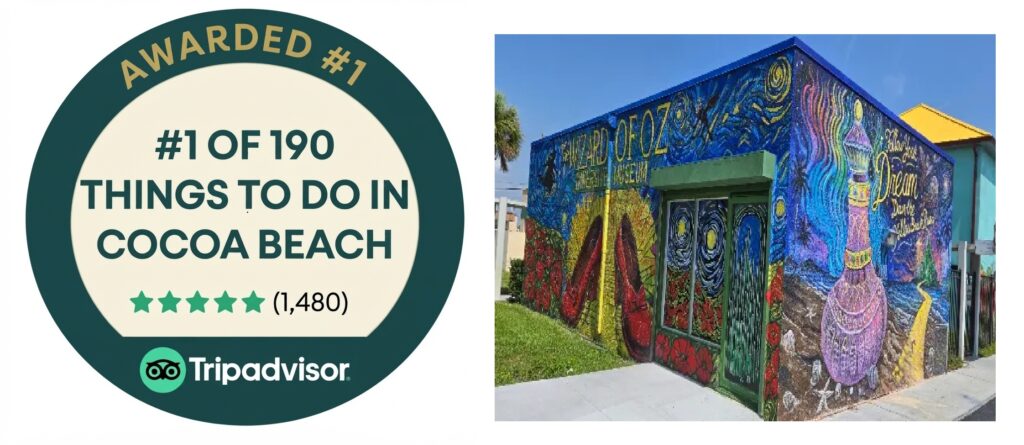
Today, the Wizard of Oz Museum in Cocoa Beach, Florida, gives visitors an opportunity to explore the history behind the familiar story.
Many people know Oz through the classic movie. Others remember reading Baum's books or encountering adaptations in different languages. Those experiences can all lead to the same question: where did this remarkable story begin?
For me, answering that question was the beginning of a much larger journey.
Explore the History of Oz in Person
Discover rare Oz books, historical memorabilia, and the stories behind the collection at the Wizard of Oz Museum in Cocoa Beach, Florida.
Explore the Museum