Wizard of Oz Museum · Museum History · Story 8
Finding a rare Oz book is exciting. Learning whether it is truly the edition you hope to find is where the real adventure begins.
As my interest in L. Frank Baum's books developed into collecting, I began thinking about what it would mean to own a genuinely early or scarce Oz edition. Reading the stories had introduced me to the Land of Oz. Researching the books introduced me to a different kind of adventure: the search for a collectible copy.
I discovered that searching for rare books involves much more than finding an appealing photograph or an exciting description. A collector must learn how to compare editions, evaluate condition, understand pricing, and recognize when important information is missing.
I cannot point to one particular purchase as the beginning of everything. What I remember most clearly about becoming an Oz collector is the gradual change in how I looked for books. The search itself became part of the fascination.
Searching Beyond the Familiar Titles
Many people know The Wonderful Wizard of Oz, first published in 1900. Fewer realize how extensive the original Oz literary tradition became.
L. Frank Baum wrote fourteen Oz novels, and the series continued after his death with contributions from other authors.
For a beginning collector, this creates an important choice. Should the collection focus on Baum's own books, early editions of the continuing series, illustrated editions, or another particular area?
The more I studied Oz publishing history, the more I appreciated the importance of having a clear collecting interest. Without one, it is easy to accumulate books without understanding how they fit together.
The Excitement of a Promising Discovery
There is something special about encountering a book that appears to be an early printing of a title you have been studying.
Perhaps the binding looks familiar from a reference book. Perhaps the publisher's imprint seems consistent with an earlier period. Perhaps the illustrations resemble those associated with the original edition.
Each observation raises a possibility. But a possibility is not proof.
The excitement of finding a promising Oz book is only the beginning. Research determines what you have actually found.
Learning to Ask Better Questions
When considering a collectible book, I learned that the questions asked before a purchase are often more important than the description supplied by a seller.
Is the title page present? Does the publisher's name match the expected edition? Are all the illustrations included? Has the book been repaired or rebound? Are there photographs of the pages needed for identification?
A listing may call a book "rare" without explaining why. That description should invite further research, not automatically justify a higher price.
I began treating descriptions as starting points. The physical evidence, supported by reliable bibliographic information, mattered much more.
Why Patience Matters in Rare-Book Collecting
Collecting can create a sense of urgency. When an interesting copy appears, it is tempting to assume that another opportunity will never come.
Sometimes a particular edition really is difficult to find. But urgency can also lead to mistakes, especially when a book's identity or condition is uncertain.
A careful collector learns to distinguish between an opportunity worth pursuing and one that requires more information.
I came to appreciate that passing on a questionable copy can be as important as buying a good one.
Price Is Not the Same as Historical Importance
Another lesson was that the price of a book does not fully describe its place in Oz history.
Some editions may command high prices because of scarcity, demand, condition, or special features. Other books may be relatively affordable while still offering valuable insight into how Oz stories reached readers.
A collection built around understanding publishing history can include both. What matters is knowing why each book belongs.
The Value of Comparing Copies
One of the most useful habits in book research is comparing multiple copies of the same title.
Differences in bindings, publisher information, illustration placement, and other physical details can become clearer when two examples are examined side by side.
Reliable photographs and bibliographic descriptions can also help when direct comparison is not possible.
This approach turns collecting into a process of learning. Each new observation can improve the way the next book is evaluated.
How the Search Shaped My Collection
Over time, my interest in rare Oz books became closely connected to the research required to understand them.
The process encouraged me to study editions carefully, document distinguishing details, and develop a deeper appreciation for the history of children's book publishing.
That knowledge eventually contributed to my work on an Oz book identification guide. It also became part of the collecting background behind the Wizard of Oz Museum.
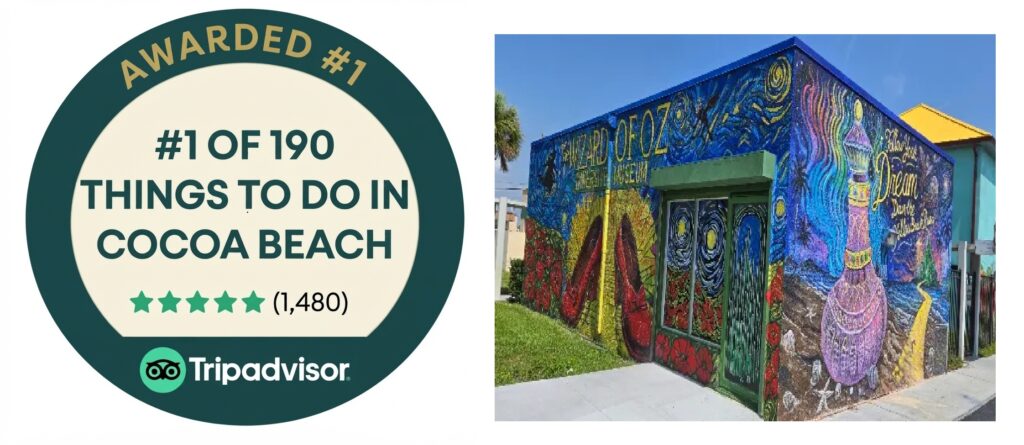
Today, visitors to the museum in Cocoa Beach, Florida, can explore the broader world of Oz through books, memorabilia, and exhibits.
For me, the search for collectible Oz books was never simply about acquiring objects. It was about understanding the stories those objects could tell.
Explore the World of Rare Oz Books
Discover Oz literature, historical collectibles, and movie memorabilia at the Wizard of Oz Museum in Cocoa Beach, Florida.
Explore the Museum