Behind the Museum · Chapter 6 of 10 · Stories 66–82 of 145
Every visitor brought a different expectation. Every review offered a new perspective. As the Wizard of Oz Museum grew, we learned to listen, adapt, and understand how other people experienced what we had built. Behind those public achievements, our family was paying a private price.
My name is Fred, and this chapter is about what happened after people began experiencing the museum for themselves.
Before opening, I knew the collection and understood why the objects mattered to me. But I could not predict how every visitor would respond.
Some guests spent a long time exploring. Others moved through quickly. Some left enthusiastic reviews, while others were disappointed.
I learned to take those reactions seriously without allowing any single opinion to define the entire museum.
These seventeen stories also reveal something visitors could not see: the strain that building the museum placed on Palina and our family.
Five Minutes vs an Hour
One of the first things I noticed about our visitors was how differently they experienced the same museum.
Some people could walk through in just a few minutes. They looked at the exhibits, recognized a few familiar characters, and continued toward the exit.
Other visitors took their time. They read the explanations, listened to the audio presentations, and explored the immersive experience.
For someone who engaged with the historical material, a visit could take around an hour.
The difference was not necessarily the number of exhibits. It was how visitors chose to interact with them.
That taught me something important: the value of a museum experience depends partly on the time and attention a visitor brings.
My First Negative Reviews Made Me Defensive
When you spend years creating something, criticism can feel personal.
That was especially true when the museum was new. I knew how much work Palina and I had invested in opening it.
When negative reviews appeared, my first instinct was to explain everything the reviewer might have misunderstood.
I wrote detailed responses, sometimes answering criticism point by point.
At the time, I believed I was defending the museum and correcting the record.
Later, I realized that a lengthy argument could create its own problems. A response might attract attention for reasons I had not intended.
I had to learn that responding professionally to criticism was different from winning an argument.
What Negative Reviews Taught Me About Expectations
Not every disappointed visitor had the same complaint.
Some arrived expecting a museum devoted mainly to the famous 1939 movie.
But our collection had a much broader historical focus, especially the original Oz books and the world that existed before the movie.
Other visitors expected a different kind of entertainment or did not spend much time engaging with the exhibits.
Even the music and atmosphere could affect someone's reaction.
I began to understand that disappointment sometimes came from a mismatch between what people expected and what we actually offered.
A museum can deliver the experience it was designed to provide and still disappoint someone who expected something else.
That lesson influenced how I described the museum online and explained it to future visitors.
I Stopped Fearing Every One-Star Review
In the beginning, a single one-star review could feel enormous.
I worried about how it might affect the museum's reputation and whether future visitors would decide not to come.
Over time, I started thinking about reviews more mathematically.
A museum with only a handful of reviews is strongly affected by every new rating.
But as a large body of genuine positive feedback develops, an individual negative review becomes less dominant.
I still wanted to understand legitimate criticism. I simply learned not to treat every low rating as a crisis.
What mattered more was the overall pattern of visitor experiences.
How We Started Asking Happy Visitors for Reviews
I discovered that visitors who enjoyed the museum did not always leave reviews.
They might thank us, tell us they had a wonderful time, and then continue with their day.
But that positive experience would not necessarily appear online.
We began encouraging satisfied guests to share their experiences publicly.
The goal was not to tell people what to write. It was to make them aware that their honest feedback could help other visitors discover the museum.
As more people shared their genuine experiences, our online reputation became a broader reflection of the audience we served.
Why Google Reviews Became So Important
For a small attraction, Google reviews are not only about reputation.
They also affect how people discover and evaluate a place they have never visited.
Travelers searching for things to do near Cocoa Beach or Cape Canaveral may encounter a museum through Google Search or Maps.
Before deciding to visit, many people look at ratings, photographs, and comments from previous guests.
I realized that our reviews were becoming part of the museum's introduction to potential customers.
A strong collection of honest visitor feedback helped people understand what kind of experience they could expect.
Why TripAdvisor Was Harder Than Google
Google was not the only platform where visitors could review us.
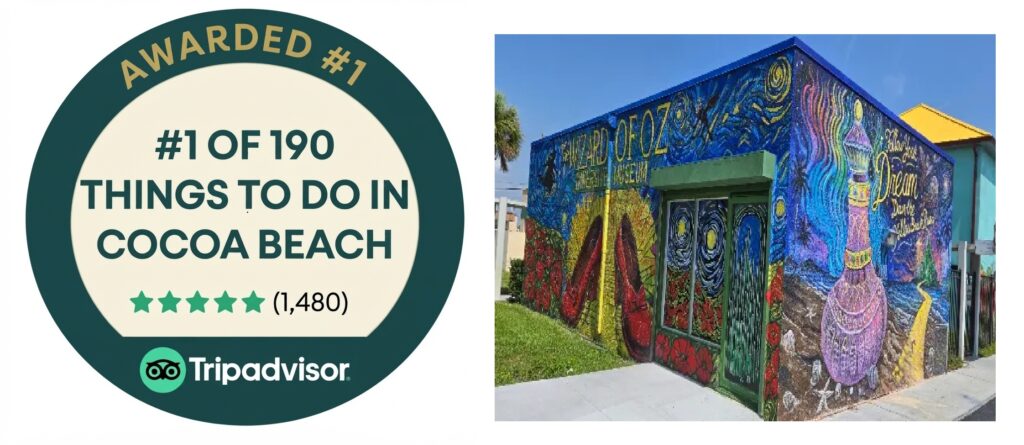
TripAdvisor was especially relevant because many travelers use it when planning attractions and activities.
But I found that getting reviews there could be more difficult.
Visitors often needed to put more effort into writing and submitting a review.
That made every new review particularly meaningful to me.
I also paid attention to how TripAdvisor compared our museum with other attractions.
Those comparisons eventually produced some results I never expected.
I Never Intended to Build America's #1 Children's Museum
When I started planning the Wizard of Oz Museum, I was thinking primarily about adults interested in books, history, and art.
I did not set out to create a children's museum.
But families began visiting, and we adjusted the experience to make it more engaging for younger guests.
Then I began noticing our position in TripAdvisor's children's-museum rankings.
I remember the museum reaching the top position in Florida and later appearing at number one nationally in that category.
What surprised me was the comparison with much larger, long-established institutions.
Our museum was small, and children's education had not been its original organizing concept.
The ranking showed me how much the actual visitor experience could differ from my initial plan.
I Changed One Online Category—and Watched Our Ranking Drop
Online platforms often allow an attraction to appear in several categories.
On TripAdvisor, our museum had been associated with categories including specialty museum, children's museum, and art museum.
After our move, I changed the order of those categories.
I placed art museum ahead of children's museum, which moved the children's category lower in the list.
Later, I noticed that our children's-museum ranking had declined.
I could not prove that the category change caused the decline. Rankings can move for many reasons.
But the timing made me wonder how much an online classification could influence the way a platform compared us.
It reminded me that the categories we choose can affect how other people discover and understand the museum.
I Needed to Know If the Museum Was Actually Good
I had spent years building the collection and creating the museum.
Naturally, I believed it had value.
But my opinion was not enough.
I wanted to know whether people who visited actually found the experience worthwhile.
Reviews helped, but I also wanted to compare feedback across different platforms.
If people consistently responded positively, that would mean more than my own enthusiasm.
I began treating independent visitor feedback as a way to evaluate whether our museum was succeeding.
The Museum Became an Arival TourReview Finalist
One day, our small museum was being recognized in a much larger attraction industry context.
The Wizard of Oz Museum became a top-ten finalist in the medium-attraction category of the Arival TourReview awards.
What made this significant to me was that the recognition involved visitor-review data.
It was not simply a claim we made about our own museum.
Our attraction was being considered alongside other experiences across North America.
I saw it as another indication that visitors were responding positively to what we had created.
For a museum that began with my private book collection, that kind of external recognition was unexpected.
An Algorithm Told Me What Kind of Museum I Built
Around 2023 or 2024, I discovered an international museum-ranking website that classified attractions in many different ways.
I was curious to see where the Wizard of Oz Museum appeared.
What surprised me was that the site did not always describe our museum the way I described it myself.
The system placed us in categories that reflected different aspects of the visitor experience.
I began to realize that outside systems were interpreting our unusual combination of literature, art, technology, and family activities.
I had built one museum, but different classification systems seemed to see several different museums inside it.
How Did an Oz Museum Become an Astronomy Museum?
One of the strangest classifications I encountered described the Wizard of Oz Museum as an astronomy museum.
That was not a category I had imagined when we first opened.
But our location on Florida's Space Coast had influenced some of the educational material we introduced.
We included content connected with the James Webb Space Telescope.
I wondered whether that science-related material had contributed to the astronomy classification.
I could not know exactly how the ranking system made its decision.
But it was an amusing example of how a museum built around Oz could develop an identity that extended far beyond its original subject.
We Were Ranked for Things I Never Designed a Ranking Strategy Around
As I explored different museum rankings, I found our attraction listed in categories I had never deliberately targeted.
I remember seeing references to guided tours, parking, child-friendly experiences, film museums, and applied art.
There were also categories connected with museums devoted to individuals and other specialized subjects.
Some of those labels made sense when I thought about the features we had added over time.
Others were unexpected.
The rankings changed, so I did not consider any particular position permanent.
But the variety of categories was revealing. It showed me how outsiders interpreted the museum through its different attractions and services.
We had not designed the experience to win a particular ranking. We had been trying to make it better for visitors.
The Museum Was Open, but Fred Was Almost Never Home
There is another side of the museum's early years that visitors did not see.
From the outside, people saw a new attraction beginning to grow.
At home, our family was experiencing the cost of that work.
During the first years, I spent so much time at the museum that Palina remembers me being almost never home.
She was taking care of the children, the house, and much of our everyday family life.
When I finally came home, I often brought the stress of construction, customer problems, money, and reviews with me.
The museum was taking more than our savings and our working hours.
We were also investing something we could never get back: time with our family.
Palina carried a large part of that burden, even when visitors had no reason to know about it.
Four Losses While We Were Building the Dream
While we were working to open and stabilize the museum, our family was also going through a painful period.
Palina remembers losing four close family members over approximately a year and a half.
These were not people who stood outside our museum story.
They knew what we were trying to do. They worried with us when problems appeared and encouraged us when the future seemed uncertain.
Their emotional support had become part of the process of building the museum.
But the demands of running a business did not disappear when our family was grieving.
We had to continue dealing with everyday responsibilities while carrying those losses.
Looking back, it is difficult to separate the museum's early struggles from what our family was experiencing at the same time.
I Wish My Mother Could See It Now
Palina's mother followed our museum journey very closely.
When contractors disappointed us, when building problems appeared, or when something else went wrong, she worried along with us.
Palina remembers that her mother sometimes cried because she knew how difficult the experience had become.
But she continued encouraging us.
She believed we could succeed because we were together, we worked as a team, and we did not give up easily.
Sadly, she died before she could see what the museum eventually became.
When I asked Palina what she would want to show her mother today, her answer was simple.
Everything.
Then Palina added something that captured both the sadness and the love behind that answer:
I think she sees it now.
The museum's history includes public milestones, visitor reviews, and unexpected recognition.
But it also includes people who believed in us and never had the chance to see how far the journey would go.
What Success Really Taught Us
This chapter began with visitor experiences and the lessons we learned from reviews.
We discovered that expectations mattered, that online feedback could influence how people found us, and that independent recognition could reveal strengths we had not anticipated.
We also learned that success could look very different from inside the family than it appeared to the public.
Behind the reviews, rankings, and awards were long working days, difficult decisions, and personal losses.
Those experiences changed how I understood the museum we were building.
The Wizard of Oz Museum was no longer only about preserving objects. It was also about the visitors who came, the people who supported us, and the family that made it possible.
Next: Chapter 7 — The Collection Keeps Growing.