Wizard of Oz Museum · Museum History · Chapter 10 · Story 47
What Building the Wizard of Oz Museum Continues to Teach Me
When I began collecting rare Wizard of Oz books, I expected to learn about literature, publishing, and illustration. I did not expect that my interest would eventually teach me so much about explaining history to other people, making decisions about a public museum, and accepting that even a subject I have studied for years can continue to surprise me. Building the Wizard of Oz Museum has required me to think beyond the interests of a collector. It has made me consider what visitors need, what historical objects can communicate, and how a museum can remain useful as circumstances change.
There is a difference between learning something for yourself and creating an experience that helps someone else learn it.
That difference has become one of the most important lessons of my museum journey.
I still approach Oz history with the curiosity that originally drew me toward rare books. But I now think about that history through the additional responsibilities of a museum founder.
Lesson One: Knowing a Subject Is Not the Same as Explaining It
As a collector, I became interested in details that might not be immediately meaningful to someone unfamiliar with rare books.
I wanted to understand differences between editions, variations in bindings, and the history of particular illustrations.
These details are important because they help identify and interpret historical publications.
But I gradually realized that presenting them to visitors requires a different approach.
Someone encountering an early Oz book for the first time may not know why a printing variation matters.
Before explaining that variation, it may be necessary to introduce the book itself, the period in which it appeared, and its place in the development of Oz.
I have learned that good interpretation begins with understanding what a visitor may already know.
Research provides the information. Communication makes that information accessible.
Lesson Two: A Museum Needs More Than Interesting Objects
A rare book can attract attention because of its age, condition, or unusual appearance.
But an object does not automatically explain its own significance.
If visitors see an old volume without context, they may appreciate its appearance while overlooking the historical information it contains.
I believe a museum has a responsibility to connect the object with the larger story.
For example, an early Oz book can introduce visitors to the history of children's publishing.
An illustration can help explain how artists contributed to the identity of a fictional world.
A later printing can reveal something about the continuing demand for a popular book.
These connections turn individual artifacts into opportunities for learning.
Building the museum has taught me to think about what each object can help visitors understand.
Lesson Three: The Familiar Can Be a Starting Point
Many people know Oz through the 1939 film rather than through Baum's original books.
As someone interested in the literary history, I naturally want visitors to discover the books that came first.
But I have learned that familiarity with an adaptation can be useful.
A recognizable character can encourage someone to ask how that character appeared in the original story.
A familiar scene may lead to questions about differences between the book and the film.
Instead of treating popular recognition as an obstacle to historical learning, I believe it can become an introduction.
The important part is helping visitors move beyond recognition toward understanding.
That approach allows the museum to welcome people who arrive with very different levels of knowledge.
Lesson Four: Historical Accuracy Requires Restraint
When studying rare books, it is tempting to reach a conclusion before all the evidence has been examined.
A book may appear older than it is. A binding may resemble an early version without proving that the copy belongs to the earliest printing.
An inscription may suggest a possible ownership history without establishing it completely.
I have learned that careful research requires restraint.
Sometimes the correct answer is that more information is needed.
That can be less satisfying than a dramatic discovery, but it is more responsible.
For a museum, I believe this lesson is especially important.
Visitors should be able to trust that historical descriptions are based on evidence.
When something is uncertain, it is better to explain the uncertainty than to present speculation as fact.
Lesson Five: Preservation Changes the Way I Think About Display
As a collector, I learned to appreciate the physical qualities of old books.
The paper, bindings, illustrations, and printing details are all part of their historical significance.
But those same qualities can make them vulnerable.
Historical books may be affected by handling, light, and environmental conditions.
Building a museum has reinforced the need to balance public access with responsible care.
I want visitors to understand the importance of the objects, but I also want those objects to remain available for future study.
That means considering not only how something can be displayed, but also whether the method of display is appropriate for its condition.
I have learned that preservation is not separate from the visitor experience. It helps make that experience possible over the long term.
Lesson Six: The Smallest Details Can Have Historical Value
Rare-book research has taught me to pay attention to details that might otherwise seem insignificant.
A small difference in printing can help distinguish editions.
A change in an illustration may provide evidence of a later version.
An unusual binding feature may suggest a question worth investigating.
These details do not always lead to important discoveries, but they encourage careful observation.
I believe that habit of looking closely is valuable for museum visitors as well.
It shows that history is not only about famous events or well-known people.
Historical understanding can also develop from examining the physical evidence that survives.
The museum offers an opportunity to introduce visitors to that way of thinking.
Lesson Seven: The Collection and the Museum Are Different Things
My collection developed through personal interest in Oz books and their history.
The museum developed from the decision to share that interest with the public.
Those two activities are connected, but they are not identical.
A collector may focus on acquiring and studying particular objects.
A museum must also consider how those objects relate to visitors, educational goals, and long-term preservation.
My wife, Palina, helped me recognize this possibility when she suggested creating a museum.
Her idea encouraged me to think about the collection as something that could have value beyond my own research.
I have learned that building a museum requires translating a personal passion into a public purpose.
Lesson Eight: Different Visitors Notice Different Things
One visitor may be drawn to the appearance of an early book.
Another may be interested in how Oz characters changed across different illustrations.
A family may focus on the imaginative elements of the experience.
Someone familiar with rare books may want to understand the bibliographic details.
I believe a museum should recognize that people approach historical subjects through different interests.
It is not necessary for every visitor to leave with the same knowledge.
What matters is providing opportunities for meaningful discovery.
Building the museum has encouraged me to think about how the same collection can communicate with people who bring different experiences and expectations.
Lesson Nine: A Museum Must Have a Clear Identity
The Wizard of Oz Museum includes rare Oz books, historical memorabilia, and immersive digital experiences.
These elements offer different kinds of engagement.
But I believe they should be connected through a recognizable purpose.
For me, the museum's identity begins with the literary and artistic history of Oz.
The original books provide a historical foundation.
Other experiences can encourage imagination and curiosity, but they should not obscure the significance of the authentic collection.
I have learned that a museum becomes easier to understand when visitors can recognize why its different elements belong together.
A clear identity also helps guide decisions about future development.
Lesson Ten: Technology and History Have Different Strengths
Modern digital presentations can create experiences that are not possible through traditional book displays.
They can use scale, movement, and visual immersion to engage visitors.
Historical books offer something different.
They preserve physical evidence of how a literary work was originally published and illustrated.
I believe both can contribute to a museum experience when their roles are understood.
A digital interpretation is not the same as an original artifact.
But it may encourage visitors to become interested in the subject represented by the artifact.
Building the museum has taught me to consider how different presentation methods can complement one another without confusing historical authenticity with modern creativity.
Lesson Eleven: Growth Requires Saying No Sometimes
When developing a collection, it can be tempting to pursue every object that appears interesting.
But I have learned that selectivity is important.
An addition may be attractive without contributing much to the museum's historical purpose.
A new presentation may sound exciting without having a clear educational connection.
I believe growth should be evaluated according to what it adds to the visitor's understanding.
That may mean deciding not to pursue an opportunity.
It may also mean spending more time researching or improving the interpretation of material already held.
For me, thoughtful development is more important than growth for its own sake.
Lesson Twelve: A Change of Location Does Not Have to Change the Mission
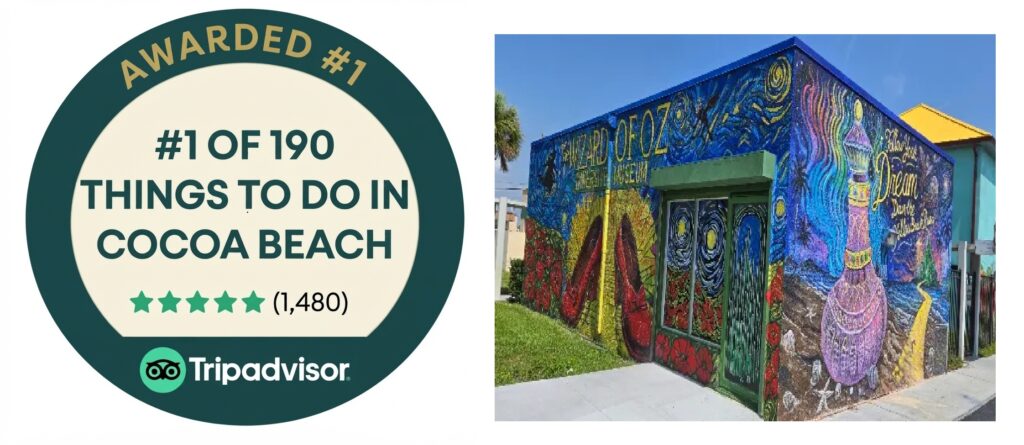
The Wizard of Oz Museum began in Cape Canaveral and relocated to Cocoa Beach in 2026.
That development became part of the museum's history.
It also reinforced an important distinction for me.
A museum's physical circumstances can change while its underlying purpose remains consistent.
The rare books, their historical significance, and the desire to share that history with visitors remain central to my thinking.
At the same time, a relocation reminds me that operating a museum involves practical decisions as well as historical interests.
I have learned to see those decisions as part of the institution's continuing development.
Lesson Thirteen: Research Is Never Completely Finished
Even after studying Oz books for years, I do not believe there is a point at which every relevant question has been answered.
Historical evidence may be incomplete.
New comparisons may reveal details that were previously overlooked.
Additional information may help clarify an uncertain identification.
I believe it is important to remain open to better evidence.
That attitude can be challenging because it sometimes requires reconsidering an earlier conclusion.
But I have learned that responsible research depends on a willingness to keep learning.
The museum should reflect that principle in the way it presents and documents historical material.
Lesson Fourteen: The Museum's Own Story Deserves Documentation
My original interest was in the history of Oz books.
Over time, I came to recognize that the museum itself was developing a history worth recording.
My childhood experience with Volkov's The Wizard of the Emerald City, my rediscovery of Baum's books through my children, and my years of collecting all help explain how the institution began.
Palina's suggestion to create a museum was another important part of that story.
The museum's beginnings in Cape Canaveral and its relocation to Cocoa Beach in 2026 are also part of the record.
I believe preserving this history can help future visitors understand why the museum exists.
It connects the institution to the personal experiences and decisions that shaped its development.
Lesson Fifteen: The Most Valuable Results Are Not Always Measurable
A museum may measure certain aspects of its activity, but some of its educational value is more difficult to quantify.
How do we measure the significance of a child becoming interested in an original Oz book?
How do we measure the value of an adult discovering the work of an illustrator for the first time?
How do we measure the questions that someone continues exploring after leaving the museum?
I do not think every meaningful outcome can be reduced to a number.
For me, the museum's purpose includes encouraging curiosity and historical understanding.
Those results may develop gradually, and their influence may continue beyond the visit itself.
That possibility remains one of the reasons I find the museum's work worthwhile.
What I Am Still Learning About Being a Founder
When I began collecting, I could concentrate on the subjects that interested me most.
Building a museum required a broader perspective.
I had to think about historical interpretation, preservation, visitor understanding, and the institution's identity.
Those responsibilities have not eliminated my curiosity as a collector.
Instead, they have given it a new direction.
I now ask not only what I can learn from an object, but also how that knowledge might be shared responsibly with others.
I believe that question will remain important as the museum continues developing.
The museum has taught me that preserving history is only part of the work. Helping other people understand why that history matters is equally important.
The Second Lesson of Chapter 10
Story 46 introduced the idea that the Wizard of Oz Museum is part of a continuing journey rather than a finished achievement.
Story 47 considers what that journey continues to teach me.
I have learned to distinguish collecting from interpretation, enthusiasm from evidence, and expansion from meaningful development.
I have learned that visitors bring different interests and that historical objects need both protection and explanation.
I have also learned that creating a museum does not mean the process of research is complete.
For me, these lessons are connected by a simple principle: a museum should remain willing to learn while helping others learn.
I hope the Wizard of Oz Museum continues to reflect that principle as its story develops.
Explore the History Behind the Museum
Visit the Wizard of Oz Museum in Cocoa Beach, Florida, to explore rare Oz books, historical memorabilia, and immersive digital experiences. Discover how a collector's curiosity developed into an ongoing commitment to preserving and sharing Oz history.
Explore the Museum